



Blog
Reducing Preventable Medical Errors: Where Simulation Fits in a Hospital’s Patient Safety Strategy
Preventable medical errors remain one of the most persistent challenges facing hospitals today. Leaders often spend time and budget chasing incident reports after harm has already occurred. A stronger patient safety strategy shifts that timeline earlier, using realistic training to surface risks before they reach a patient. Simulation lets clinical teams rehearse high-stakes scenarios and practice communication under pressure. It also exposes the gaps that standard training can miss.
Building a Patient Safety Strategy Around Real Clinical Behavior
Most hospital safety programs rely on policies, checklists, and post-incident reviews. Those tools matter, but they describe what should happen rather than what actually happens under pressure. Clinical simulation captures real behavior instead of hypothetical behavior. It shows how a team communicates during a code and how quickly a handoff gap gets caught.
Elevate Healthcare (formerly CAE Healthcare) approaches this through clinical simulation built on modeled physiology. Learners respond to patients whose vital signs and breathing change the way a real patient’s would. That level of realism gives safety leaders behavior to study, not just protocols to audit. Software like Maestro drives that physiological response, giving facilitators a validated model instead of a scripted set of cues.
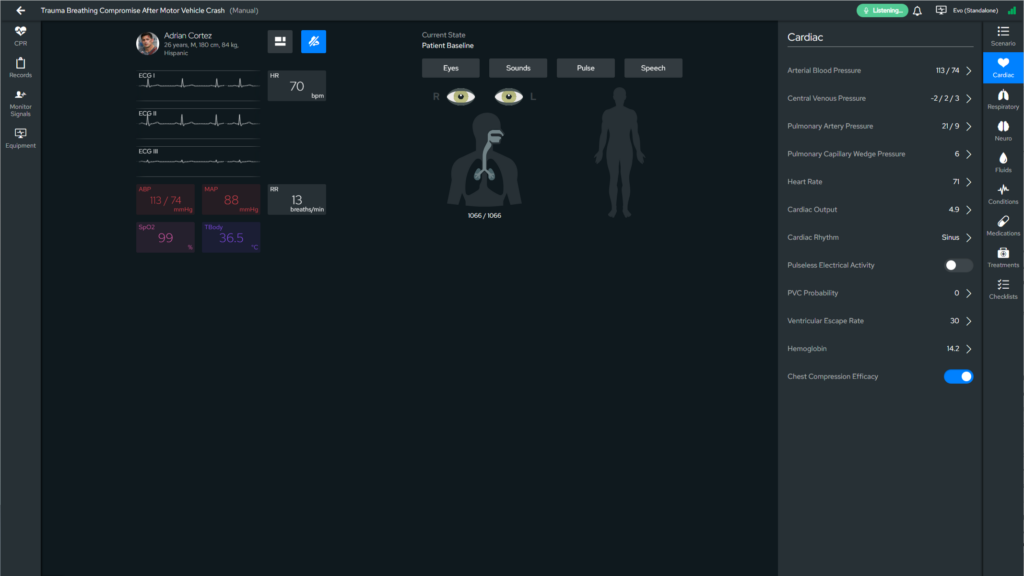
A patient’s heart rate, oxygen saturation, and breathing pattern react to interventions in real time. That responsiveness matters for a patient safety strategy focused on catching errors before they compound. A wrong dose or a delayed intervention produces a visible physiological consequence during the scenario, not a hypothetical one described afterward.
What Types of Errors Can Simulation Help Uncover?
Medication errors, communication breakdowns, and delayed escalation account for a large share of preventable harm. Many of these errors never show up in incident reports because nothing goes wrong that day. Simulation exposes the near misses that routine operations tend to hide.
A scenario built around a deteriorating patient can reveal whether a team recognizes early warning signs quickly enough. It can also show whether a handoff includes the right information or drops something critical along the way. These findings give safety leaders a much earlier signal than waiting for an actual adverse event.
How In-Situ Simulation Identifies Latent Safety Threats
Traditional simulation labs are useful, but they cannot replicate every condition of a working unit. In-situ simulation runs scenarios inside the actual clinical environment, using real equipment, real supply locations, and real staffing patterns. That approach uncovers latent safety threats that a lab setting would never reveal.
A crash cart missing a key item, a medication stored in the wrong place, or a broken alarm can all surface during a single in-situ exercise. Capturing that data used to require fixed cameras and dedicated recording rooms. LearningSpace Anywhere removes that barrier by turning authorized mobile devices into secure wireless cameras. Teams can record a scenario in a supply closet, a hallway, or a temporary unit without installing new hardware. That flexibility means safety leaders can run in-situ exercises anywhere risk is suspected, not just where the equipment happens to be.
Debriefing and Safety Improvement
A simulation without a strong debrief only captures half the value. The debrief is where a team connects what happened during the scenario to what needs to change in practice. Facilitators walk through decisions, communication patterns, and near misses while the experience is still fresh. This structured reflection is what turns a single training event into a repeatable improvement process.

LearningSpace supports the debriefing process by capturing HD video, simulator data, and facilitator notes in one platform, giving faculty a complete record of each session to reference during and after the debrief. It also supports assessment through Ehli, LearningSpace’s AI assistant. Ehli can transcribe sessions and suggest checklist scores with timestamped evidence, helping evaluators assess performance more efficiently. Faculty remain in control of every score while spending less time manually reviewing session footage.
How Simulation Findings Strengthen a Patient Safety Strategy’s QI Loop
Findings from a single scenario are useful, but trends across many sessions are what actually move a quality improvement program forward. LearningSpace reporting tools let safety teams track patterns across units, shifts, and scenario types. A recurring communication breakdown during handoffs, for example, points to a process problem rather than an individual one.
That kind of trend data gives QI teams a defensible starting point instead of a single anecdote. Connecting these findings to formal QI channels is what separates a patient safety strategy that produces lasting change from one that stays confined to the training calendar.
Turning a Patient Safety Strategy Into a Repeatable Program
None of this works as a one-time event. Errors and near misses evolve as staffing, technology, and patient acuity shift, so a training program needs a similar rhythm to stay useful. Building that rhythm requires not only the right tools, but also a program designed around your organization’s specific gaps and patient safety priorities.
This is where Elevate Learning Institute can help. Its team of clinical educators can conduct a gap analysis to identify opportunities for improvement and help healthcare organizations develop a patient-safety-focused simulation program. Rather than taking a one-size-fits-all approach, this process aligns training with the clinical challenges, skills gaps, and safety goals that matter most to your team.
Once those priorities are established, the right simulation equipment can support consistent, repeatable training. Elevate Healthcare offers a full range of simulation equipment built for high-realism clinical education. Patient simulators let teams rehearse deteriorating patients, code scenarios, and complex handoffs with physiological responses that mirror real clinical events. Ultrasound simulators help teams build diagnostic accuracy in procedures where a missed finding can turn into a safety event. Task trainers and accessories support the repetitive, hands-on practice that keeps core clinical skills sharp between larger scenarios.
A patient safety strategy is only as strong as the training behind it. With the right assessment, program design, and simulation tools, healthcare organizations can turn safety priorities into a sustainable training program. Connect with Elevate Healthcare to explore how its team can support your simulation and patient safety goals.