



Blog
What Is Clinical Simulation? A Practical Guide for Healthcare Educators and Program Leaders
Healthcare education has always faced a fundamental tension: learners need clinical experience to develop competence, but real patients cannot serve as the practice ground for that development. Clinical simulation addresses that challenge by creating structured learning environments where healthcare professionals can practice clinical judgment, technical skills, and team communication under conditions that closely mirror real patient care without placing actual patients at risk.
For nurse educators, hospital education leaders, and new simulation program directors, the question is rarely whether simulation works. Research continues to demonstrate its value across healthcare education and workforce development. Instead, the more valuable questions are which types of simulation support specific learning goals, when different fidelity levels are appropriate, and how to build a program that connects simulation activities to measurable clinical outcomes.
The Main Types of Clinical Simulation
Clinical simulation spans several distinct modalities, each serving different educational purposes.
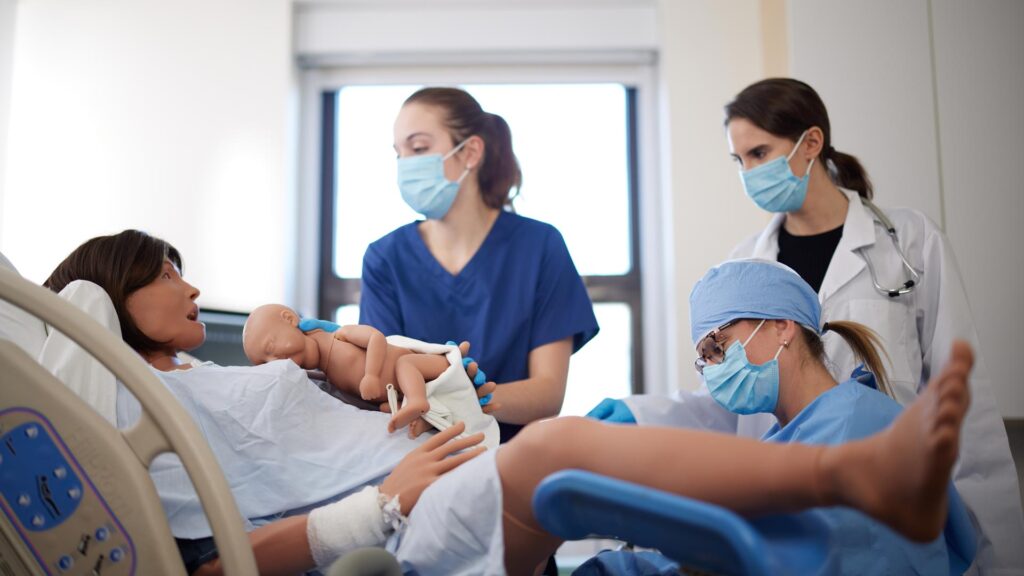
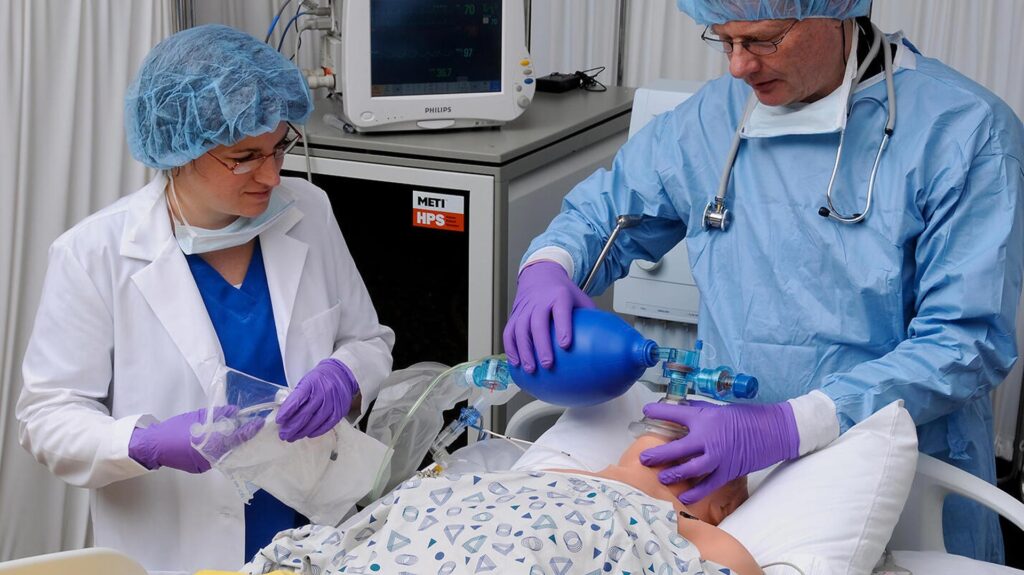
Manikin-based simulation uses patient simulators ranging from basic task trainers to high-fidelity full-body systems capable of replicating complex physiology. These simulators allow learners to practice clinical assessment, emergency response, medication administration, and team-based care through scenarios that can be designed, repeated, and debriefed consistently.
High-fidelity patient simulators such as Elevate Healthcare’s (formerly CAE Healthcare) HPS, Evo, and Lucina platforms reproduce cardiovascular, respiratory, and obstetric physiology with the realism needed to support advanced clinical decision-making.
Standardized patient simulation uses trained actors who portray patients with specific clinical presentations. This approach is particularly effective for communication skills, history-taking, physical examinations, and sensitive conversations where human interaction itself is the primary learning objective. The Association of Standardized Patient Educators (ASPE) maintains dedicated best practice standards for this modality alongside INACSL and SSH frameworks.
Task trainers are partial anatomical models designed to develop procedural proficiency in specific skills such as IV insertion, intubation, lumbar puncture, and urinary catheterization. Because they focus on a single procedure, they provide high-repetition practice at a lower cost than full-body simulators. Elevate Healthcare’s task trainer portfolio supports procedural skill development across multiple clinical specialties.
Virtual reality simulation uses immersive digital environments to recreate clinical scenarios. It is increasingly valuable for procedural rehearsal, exposure to rare clinical events, and scalable distance learning when physical simulation resources are unavailable. Through Elevate Healthcare’s partnership with SimX, simulation programs can integrate immersive virtual experiences alongside traditional manikin-based training.
Fidelity Levels and When Each Applies in Clinical Simulation
Fidelity refers to the degree to which a simulation replicates the real clinical environment. While simulation is commonly categorized as low, medium, or high fidelity, the practical application is more nuanced than simply choosing the most advanced technology.
Research does not support one fidelity level as universally superior. Rather, the appropriate level depends on the learning objectives. A learner practicing basic IV insertion does not require a high-fidelity physiologic simulator. A multidisciplinary team managing a simulated sepsis patient with deteriorating vital signs, ventilator management, and family communication does.
A meta-analysis examining fidelity and nursing education outcomes found that educational effectiveness is not directly proportional to fidelity level. Consequently, simulation programs should incorporate a variety of modalities to address different educational goals. For program directors, the objective is to match the level of fidelity to the desired learning outcome rather than defaulting to the highest-fidelity option for every scenario.
High-fidelity simulation delivers the greatest value in scenarios requiring complex physiologic responses, advanced clinical reasoning, and coordinated team communication under pressure. For these situations, simulators that breathe, generate realistic vital signs, respond to interventions, and support dynamic scenario progression create the cognitive demands necessary for deeper learning. Elevate Healthcare’s adult critical care, obstetric, and neonatal simulators are designed specifically for these applications.
How Clinical Simulation Is Used Differently in Academic and Hospital Settings
Although the technology may be similar, the goals of clinical simulation differ significantly between academic institutions and healthcare organizations.
In academic settings, simulation primarily supports pre-licensure education. Nursing programs use simulation to supplement clinical placement hours, develop foundational procedural skills, and strengthen clinical judgment before students begin caring for actual patients. Accreditation bodies, including the National Council of State Boards of Nursing (NCSBN), provide guidance for incorporating simulation into nursing curricula as a substitute for certain clinical hours.
By comparison, hospital-based simulation focuses on practicing clinicians rather than students. Common objectives include onboarding new hires, verifying ongoing competency, preparing teams for high-risk, low-frequency events, conducting in-situ patient safety drills, and developing advanced leadership skills. As a result, scenarios are designed around the institution’s patient population, workflows, and operational risks.
What Standards Govern Best Practice in Clinical Simulation?
Two organizations provide the primary framework for healthcare simulation standards.
The International Nursing Association for Clinical Simulation and Learning (INACSL) publishes the Healthcare Simulation Standards of Best Practice. Since their introduction in 2011, these standards have guided simulation design, facilitation, debriefing, outcomes assessment, faculty development, and professional integrity across academic and clinical environments. Importantly, the standards continue to evolve alongside emerging research.
The Society for Simulation in Healthcare (SSH) complements these standards through its accreditation framework, which evaluates simulation programs across operations, assessment, program management, and outcomes measurement. Its Standards of Performance define the processes and organizational characteristics associated with high-quality simulation programs in a wide range of healthcare settings.
For new simulation program leaders, these standards provide a practical roadmap for building programs capable of meeting institutional expectations and accreditation requirements. They also serve as a foundation for faculty development, scenario design, and structured debriefing.
How Clinical Simulation Connects to Patient Safety and Clinical Outcomes
Ultimately, the strongest justification for simulation is not simply educational innovation. It is improved patient safety.
Clinicians who repeatedly practice complex scenarios, receive structured feedback, and strengthen their clinical decision-making through simulation arrive at the bedside better prepared to recognize deterioration, communicate effectively under pressure, and respond confidently during critical events.
Clinical simulations are commonly classified as low, medium, and high fidelity, but the design of the learning experience itself plays an equally important role in determining educational effectiveness. When scenarios are thoughtfully designed and paired with structured debriefing, simulation-based education can improve clinical performance, communication, and error recognition across healthcare specialties.
Elevate Healthcare builds its simulation ecosystem around that connection. Its simulator portfolio spans major clinical environments, while LearningSpace captures the performance data that helps connect simulation practice to measurable outcomes. The Elevate Learning Institute further supports faculty development and program design for organizations building or expanding their simulation infrastructure.
Program leaders ready to build a clinical simulation program on a scalable foundation can connect with a simulation specialist to learn how the Elevate Healthcare ecosystem supports long-term program growth.