


Blog
What Is Simulation Training in Healthcare? Types, Benefits, and How Programs Use It
Every clinician needs a safe place to practice before real patients depend on them. Simulation training provides that space, giving learners realistic clinical experiences without putting patients at risk. Well-designed programs build skills, confidence, and teamwork that can carry into patient care.
The difference between a good program and a great one often comes down to structure. Scenario design, facilitation, and debriefing all shape what learners take away. This guide explains the main types, the documented benefits, and the elements every strong program needs.
What Is Simulation Training in Healthcare?
Simulation training is a teaching method that recreates clinical situations so learners can practice care in a controlled setting. Learners assess patients, make decisions, and perform interventions while educators observe and guide. Each session includes a debrief that connects actions to clinical reasoning.
The approach follows a simple cycle of prebriefing, scenario, and debriefing. Prebriefing sets objectives and establishes psychological safety before the scenario begins. The scenario provides the experience, and the debrief helps turn that experience into lasting learning.
Simulation training serves learners at every career stage. Students use it to build foundational skills and prepare for licensure, while practicing clinicians use it to maintain and develop their competence. Many programs also incorporate simulation into nursing curricula to support clinical judgment and NCLEX readiness.
What Types of Simulation Training Exist?
Programs choose from several simulation modalities, and each one supports different learning goals. Manikin-based simulation uses full-body patient simulators that breathe, show changing vital signs, and respond to treatment, depending on the model and its capabilities. Learners use them to manage acute events like sepsis, respiratory failure, or cardiac arrest.
Task trainers focus on specific procedures such as IV access, intubation, or ultrasound-guided skills. Standardized patients, trained actors who portray patients, help learners practice communication and history-taking. Hybrid simulation combines these approaches, such as an actor wearing a task trainer during a procedure.
Virtual and screen-based simulation extends practice beyond the simulation lab and can offer learners greater flexibility in when and where they train. AI tools such as Elevate Healthcare’s (formerly CAE Healthcare) MaestroAI add AI-powered patient conversations and help educators draft scenarios more efficiently, while faculty retain control over scenario review and the learning process.
What Are the Documented Benefits of Simulation Training?
Research has found that virtual reality simulation can improve nursing competency. Studies have also linked simulation-based learning to stronger motivation, self-efficacy, and critical thinking, although results can vary by study design, learner population, and type of simulation.
Regulators have also expanded the role of simulation in nursing education. The UK Nursing and Midwifery Council increased the amount of simulated practice that can count toward practice learning requirements from 300 to 600 hours. Nursing Open reported that the change came in response to challenges including limited clinical placement capacity.
Workforce readiness is another potential benefit. Transition programs that incorporate simulation can help new nurses develop clinical skills and confidence as they move into practice. These programs may also support retention, although outcomes depend on the broader transition program and workplace environment.
How Do Programs Structure Scenarios and Debriefing?
Strong scenarios start with clear, measurable learning objectives. Educators then build a patient story, set physiological parameters, and plan how the case will change based on learner actions. Many programs follow the INACSL Healthcare Simulation Standards of Best Practice to guide this design work.
Realism matters, but fidelity should match the objective. A communication scenario may need only a standardized patient, while a rapid response drill may call for a high-fidelity simulator. Choosing the right level keeps sessions focused and makes better use of faculty time.
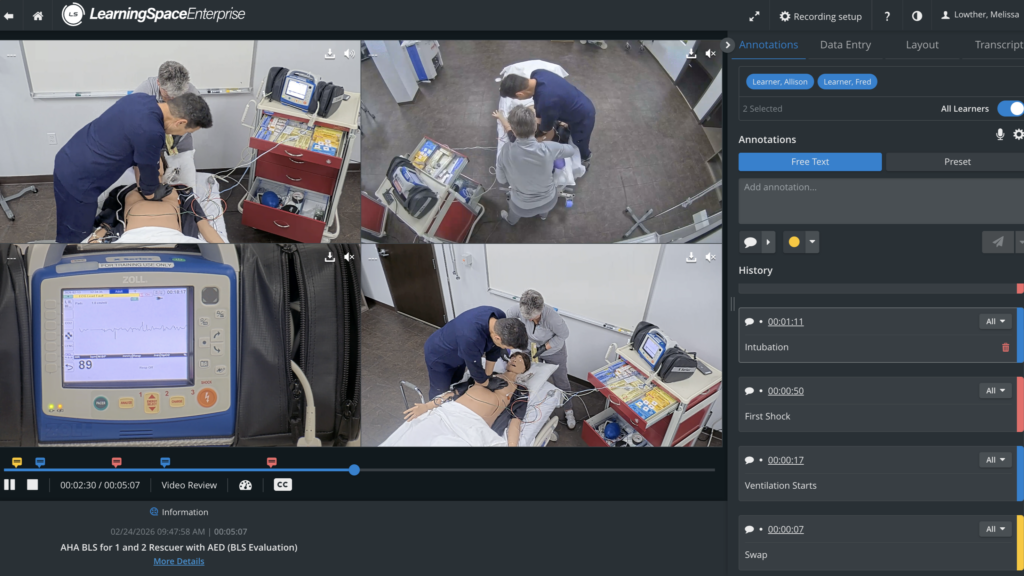
Many educators consider debriefing one of the most important parts of a simulation session. Skilled facilitators use structured models to help learners reflect on what happened and why. Platforms like LearningSpace support this process with session recording, video review, and performance assessment.
Facilitator skill directly affects the learning experience. Educators need training in scenario design, debriefing methods, and fair assessment practices. Specialized programs through Elevate Learning Institute help faculty and staff build these skills.
What Are Common Challenges in Simulation Training?
Faculty time remains one of the biggest barriers. Writing scenarios, running sessions, and leading debriefs all require significant preparation. Programs with small teams often struggle to offer enough sessions for every learner.
Equipment use presents another challenge. Some programs invest in advanced simulators but lack the training to use them fully. Others struggle with scheduling, maintenance, or aligning simulation with the broader curriculum.

Measuring impact can also prove difficult. Leaders need data that connects simulation training to competency, retention, and safety outcomes. Strategic consulting through Elevate Healthcare’s Achieve Program helps teams identify gaps, set priorities, and align simulation with clinical goals and standards.
How Do Simulation Training Outcomes Connect to Patient Safety?
Simulation training supports patient safety by giving teams opportunities to practice high-risk events before they happen in real care. In-situ simulation in hospital settings can meaningfully improve clinical outcomes, including lower patient mortality.
In situ sessions can also reveal latent safety threats inside real care areas. Teams may discover a missing supply, a confusing alarm, or an unclear escalation pathway. Addressing these issues during training can help reduce risks before they affect patients.
Regular practice also gives teams opportunities to strengthen communication. Clinicians rehearse closed-loop communication, role clarity, and speaking up under pressure. When reinforced through ongoing training and clinical practice, these habits can contribute to a stronger safety culture across units and programs.
Build Simulation Training That Prepares Teams for Real Care
Effective simulation training brings together realistic technology, skilled facilitation, and clear outcomes. Elevate Healthcare supports these needs through simulation technology, education, and program consulting. Its solutions help organizations develop clinicians who are better prepared for clinical practice.
Elevate Healthcare’s patient simulators use Maestro software to support realistic, responsive physiology in simulation scenarios. Ultrasound simulators give learners guided practice in image acquisition and interpretation. Task trainers and accessories support focused, repeatable practice with essential procedures.
LearningSpace supports session recording, video-based debriefing, and assessment. Elevate Learning Institute and the Achieve Program add education and consulting to help strengthen faculty skills and simulation program design. Talk to the Elevate team today to explore how simulation training can support your program’s goals.