



Blog
Simulation in Nursing Education: Designing Labs That Improve Readiness and Support NCLEX Success
Nursing programs face a consistent challenge: preparing students for the complexity of clinical practice before they ever step into a hospital. Nursing simulation education has become an important bridge between classroom instruction and clinical placement. The question most program directors are now working through is not whether simulation belongs in the curriculum. It is how to design a simulation lab that reliably builds the clinical reasoning and procedural competency that NCLEX and clinical employers expect.
What the Evidence Says About Simulation and NCLEX Readiness
Research on simulation and NCLEX outcomes is substantial and continues to grow. According to a study, substituting up to 50% of traditional clinical hours with high-quality simulation produced comparable educational outcomes. More recent work has focused on the specific conditions under which simulation produces licensure-ready graduates.
Scenario design, debriefing quality, and assessment consistency appear repeatedly as the variables that determine whether simulation hours translate into clinical competency. High-fidelity equipment creates the conditions for learning. Structured faculty practices around scenario design and debriefing help ensure that learning is reinforced and retained.
Choosing the Right Fidelity Level for Nursing Skills Labs
Not every nursing scenario requires a high-fidelity simulator. In fact, matching fidelity to the learning objective is one of the most important design decisions a program can make. Mid-fidelity simulators are well suited for foundational nursing skills. Physical assessment, medication administration, IV access, Foley catheter insertion, and wound care all require repetition at volume.
Students need to perform these skills repeatedly before they develop reliable procedural fluency. A mid-fidelity simulator purpose-built for clinical skills practice supports that repetition without the added complexity of a full high-fidelity system.
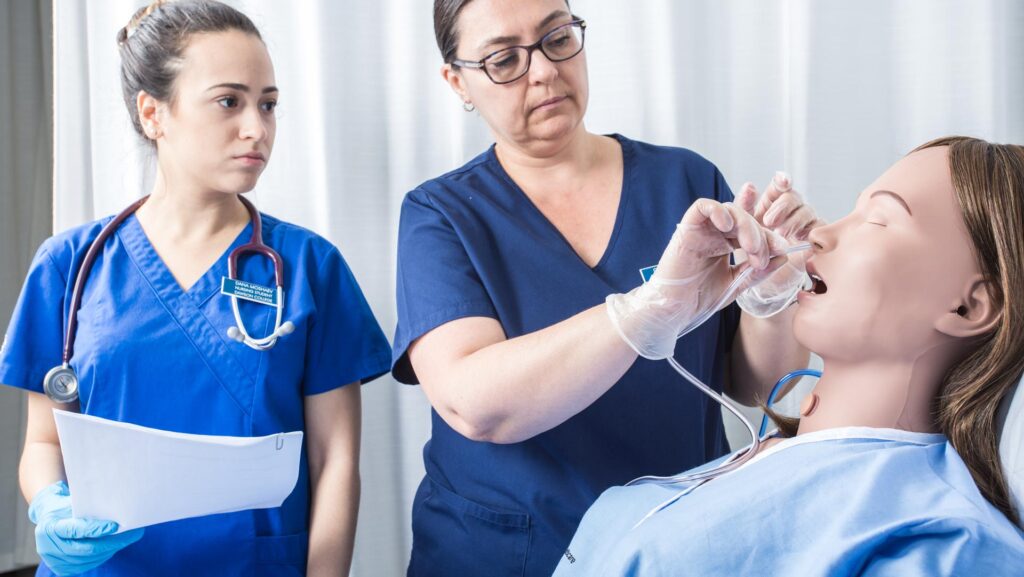
Elevate Healthcare’s Juno is designed for this use case. It gives nursing programs a dedicated platform for high-volume skills practice and competency checkoffs. Faculty can run multiple students through the same assessment scenario during a single lab session. That efficiency can make a meaningful difference for programs managing large cohorts with limited lab availability.
High-fidelity simulators become essential when the learning objective shifts to clinical reasoning. Scenarios involving patient deterioration, multi-system assessment, priority setting, and emergency response require a simulator that responds dynamically to learner decisions.
Apollo, Elevate Healthcare’s prehospital and nursing patient simulator, supports this more complex clinical reasoning. Programs that sequence Juno for foundational skills and Apollo for clinical reasoning scenarios create a deliberate progression that mirrors the increasing complexity students encounter throughout the curriculum and on the NCLEX.
Designing Nursing Simulation Education Scenarios for NCLEX Alignment
NCLEX Next Generation (NGN) tests clinical judgment across six cognitive skills: recognize cues, analyze cues, prioritize hypotheses, generate solutions, take action, and evaluate outcomes. Simulation scenarios designed around this framework provide learners with opportunities to practice the same clinical thinking expected during licensure.
Each scenario should present an initial patient state that requires recognition. The simulator’s physiological responses should require learners to analyze what they observe and form a clinical hypothesis. Scenario progression should encourage prioritization before faculty intervene. The debrief should then close the loop by walking through each cognitive step explicitly.
Faculty designing scenarios for NCLEX alignment benefit from building backward from the target cognitive skill rather than forward from a clinical diagnosis. A scenario designed to assess priority setting looks different from one designed to assess cue recognition, even when both involve the same patient presentation. Programs that distinguish between these objectives help learners strengthen the clinical judgment skills required for the NGN exam.
How Debriefing Reinforces Nursing Simulation Education Outcomes
Debriefing is where simulation learning is reinforced. Research consistently identifies structured debriefing as one of the variables most closely associated with durable learning outcomes. A well-run scenario followed by a poor debrief produces less learning than a moderate scenario followed by a structured, faculty-led discussion.
The practical challenge for nursing programs is that debriefing is faculty-intensive. Running a scenario for six students requires a skilled facilitator to review performance, guide reflection, and help learners close skill gaps in real time. Programs with large cohorts and limited faculty often find debriefing becomes the bottleneck.
LearningSpace addresses this challenge by capturing AV recordings of every simulation session, allowing faculty to anchor debrief conversations to specific moments in the scenario rather than relying on memory alone. Students can review their own performance, while faculty spend less time reconstructing events and more time facilitating the clinical conversations that support learning.
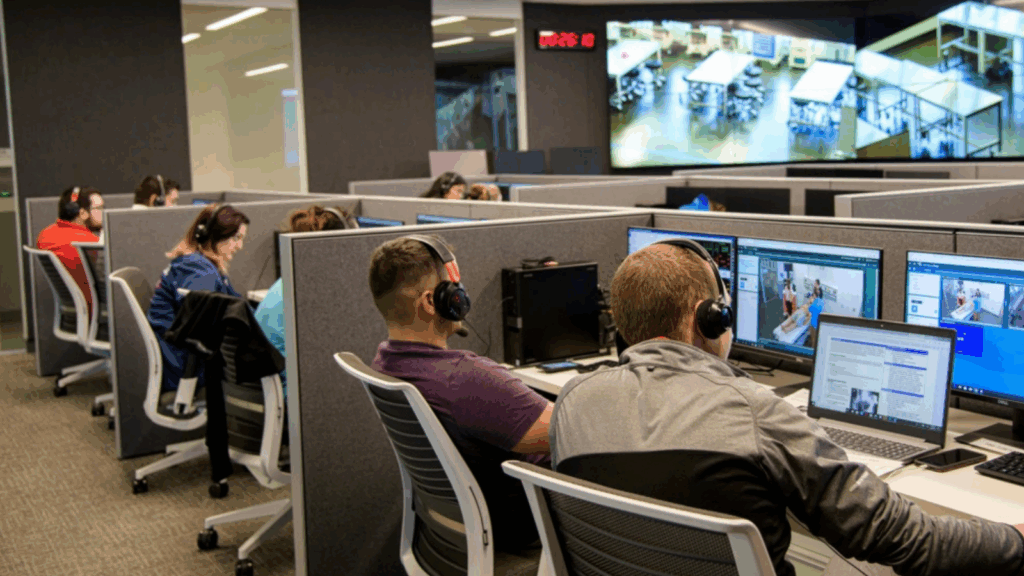
LearningSpace also supports the structured debriefing frameworks recommended in nursing simulation best practice. The Gather-Analyze-Summarize model, the PEARLS framework, and other evidence-based approaches can be incorporated into faculty workflows through the platform’s debrief tools. Consistency in debriefing across faculty and cohorts is one of the key benefits of implementing a connected simulation management platform.
Assessment and Competency Documentation in Nursing Simulation Education
NCLEX readiness is ultimately a competency claim. Programs that make that claim convincingly to students, clinical partners, and accreditors need documentation that goes beyond attendance records and faculty observation notes.
LearningSpace generates structured competency data from every simulation session. Scenario performance, evaluator scoring, and debrief outcomes are stored and retrievable in formats that support accreditation review. Ehli, the AI-powered evaluation assistant built into LearningSpace, supports scoring during OSCE sessions, allowing faculty to spend more time coaching learners and less time on documentation.
For programs preparing for ACEN or CCNE accreditation reviews, this data infrastructure matters. Reviewers expect to see evidence of systematic competency assessment, not just simulation participation. Programs that can demonstrate a direct connection between simulation activities, competency documentation, and learner progression are in a stronger position during the accreditation process.
Scaling Nursing Simulation Education Without Scaling Faculty
The constraint most nursing programs encounter as they grow is not equipment. It is faculty time. Adding simulator bays without the supporting infrastructure for scheduling, assessment, and debriefing can make programs busier without necessarily making them more effective.
At Elevate Healthcare, simulation specialists work with nursing programs at every stage, from initial lab design through curriculum integration and accreditation preparation. Connect with a simulation specialist to discuss your program’s clinical scope and design the right simulation infrastructure to support your educational goals.