


Obstetric Emergency Simulation: How High-Fidelity OB Training Reduces Maternal Mortality Risk
Obstetric emergencies unfold fast, often with little warning before a routine delivery turns critical. Teams that have never practiced a shoulder dystocia or a postpartum hemorrhage response together can lose precious time working out roles in the moment. High-fidelity OB training lets clinical teams rehearse these exact scenarios long before a real patient is on the table, building the muscle memory that changes outcomes when it matters most.
Which OB Emergencies Are Best Suited to High-Fidelity OB Training?
Certain obstetric emergencies benefit disproportionately from simulation because they combine rapid physiological change with the need for fast, coordinated action. Shoulder dystocia is a clear example, requiring a specific sequence of maneuvers performed correctly within minutes.
Postpartum hemorrhage presents a similar challenge, since recognizing the early signs of excessive bleeding and responding with the right interventions in order can prevent a situation from escalating further. Preeclampsia and eclampsia scenarios add another layer of complexity, since they require teams to manage both maternal and fetal status simultaneously under pressure.

These are precisely the situations where reading about a protocol falls short of practicing it. A team that has walked through a scenario, felt the time pressure, and made the calls together develops a different kind of readiness than one that has only reviewed a checklist.
How Team Training Improves Response Under Pressure
Obstetric emergencies rarely involve a single clinician acting alone. Nurses, physicians, anesthesiologists, and support staff must coordinate quickly, and that coordination breaks down fast without practice. Team-based simulation exposes exactly where communication gaps exist, whether that means unclear role assignment during a code or confusion about who is tracking time during a hemorrhage response.
Rehearsing these scenarios as a full team improves communication for high-stakes moments. When everyone has practiced calling out vital signs, blood loss estimates, and intervention steps the same way, the actual emergency moves faster because no one is guessing what a teammate means. That shared language is hard to build through individual training alone, which is why interprofessional team simulation has become central to obstetric emergency preparation.
Why Physiological Realism Matters in Maternal Scenarios
A scenario only builds real competency if the simulated patient responds the way an actual patient would. Maestro, with modeled physiology, drives this kind of realism by modeling how vital signs, breathing, and cardiac function change in response to interventions during a scenario. That responsiveness matters enormously in obstetric training, where maternal and fetal status can shift within seconds during an emergency.
Lucina, Elevate Healthcare’s (formerly CAE Healthcare) high-fidelity obstetric simulator, brings this physiological modeling directly into maternal-fetal scenarios through integrated maternal-fetal response, programmable uterine contractions, and support for complications like shoulder dystocia and postpartum hemorrhage.
Learners can practice epidural infusion, catheterization, and advanced airway management on the same simulator, all while the underlying physiology reacts to their actions in real time. That level of realism is what separates meaningful rehearsal from a scripted exercise with a predetermined outcome.
How Debriefing Reinforces Safety Behaviors
The scenario itself is only half the learning experience. Structured debriefing helps a team connect what happened during a simulated emergency to what needs to change in real practice. Facilitators can walk through decision points, communication breakdowns, and near misses while the experience is still fresh in every team member’s mind.
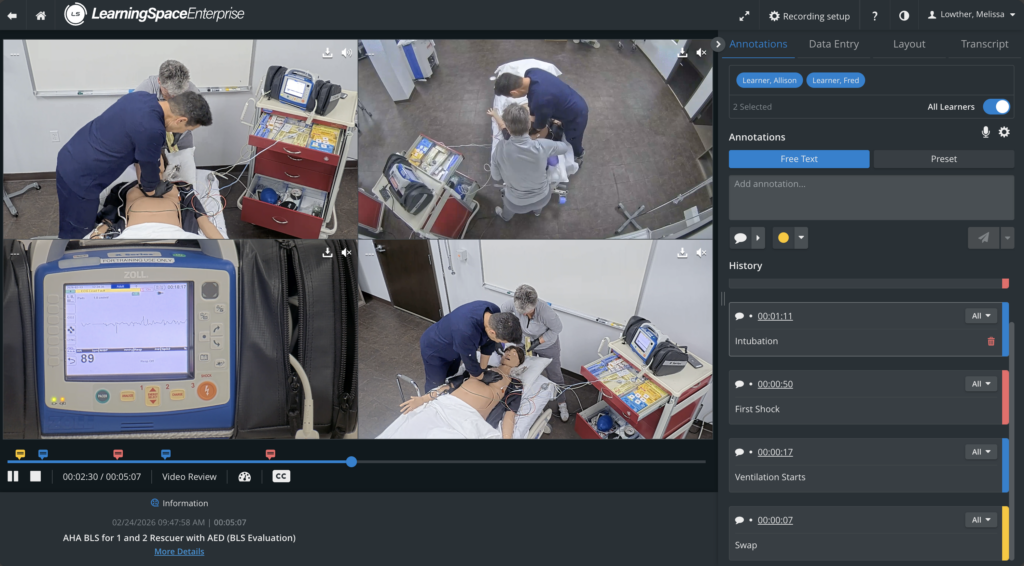
LearningSpace supports this process by capturing HD video and session data that facilitators can review alongside the team, turning a single scenario into a concrete discussion about specific moments rather than a vague recap. Elevate Learning Institute’s Safety and Teamwork and OB-specific education tracks build on this further, giving facilitators structured frameworks for running these debriefs consistently across a program rather than leaving debrief quality to individual style.
The Role of Task Trainers Alongside High-Fidelity OB Training
Full-scale team scenarios are not the only piece of a complete obstetric training program. Task trainers give learners a way to build precise technical skill in isolation before applying it under the pressure of a full scenario. Practicing cervical dilation assessment, instrumented delivery, or perineal repair on a dedicated trainer builds the tactile precision that a team-based scenario can then put to the test.
Elevate Healthcare’s partnership with Paradigm Medical Systems brings a dedicated line of OB/GYN task trainers into this picture, covering skills from labor assessment to instrumented delivery and perineal repair. Pairing that tactile, skills-focused practice with the full physiological realism of a high-fidelity simulator gives learners a continuum, moving from individual technique to coordinated team response without a gap in between.
Connecting High-Fidelity OB Training to Maternal Outcomes Goals
Simulation only creates lasting value when it connects back to a program’s broader maternal safety goals. Tracking scenario performance over time, alongside clinical metrics like response times or complication rates, shows whether training translates into practice rather than staying confined to the simulation lab. That connection turns a training calendar into a genuine patient safety strategy.
Elevate Healthcare supports that full continuum, from realistic obstetric simulators to structured team training. A broad range of patient simulators supports scenario-based training across specialties, while task trainers complete an obstetric training program.
Talk to a simulation expert about building an obstetric emergency training program that connects practice to real maternal outcomes today.