



Blog
How Patient Simulators Respond to Medications: What Educators Need to Know
Medication decisions are among the highest-stakes moments in clinical care, and among the most difficult to teach without direct patient exposure. A learner can read about vasopressor titration, study the pharmacology of antiarrhythmics, and still arrive at the bedside without the decision-making experience that real clinical situations demand.
The question of how patient simulators work in a medication context is ultimately a question of whether the simulator can close that gap.
How Simulation Manikins Replicate Medication Effects
A manikin that responds to medications physiologically does not simply follow a predetermined script. Instead, it uses a pharmacological model to determine how the simulated patient responds.
When a learner administers a medication such as a vasopressor, the simulator can account for factors including the medication, dose, timing, and patient’s current physiological state before generating a response. For example, administering norepinephrine to a simulated septic patient with low blood pressure can produce a cardiovascular response that reflects the interaction between the medication and the patient’s condition.
The same principle can apply across different medication classes. Antiarrhythmics can affect cardiac conduction and rhythm. Analgesics can affect respiratory rate and depth. Sedatives can produce hemodynamic changes depending on the patient’s baseline condition.
High-fidelity simulation has long used manikins with programmable physiological responses to clinical scenarios and disease states. Physiologically modeled platforms take this capability further by calculating the patient’s response based on the learner’s intervention rather than simply progressing through a predetermined scenario pathway.
This distinction gives learners the opportunity to experience a dynamic relationship between their clinical decisions and the patient’s condition.
What Separates a Scripted Drug Response From a Modeled One
In a scripted simulator, a faculty member or technician triggers the next patient state. The learner administers epinephrine, for example, and the instructor manually pushes a button that produces a vital change.
The change may be clinically reasonable, but it is not driven by the drug, the dose, the timing, or the patient’s current physiology. It is a human decision dressed up as a clinical response.
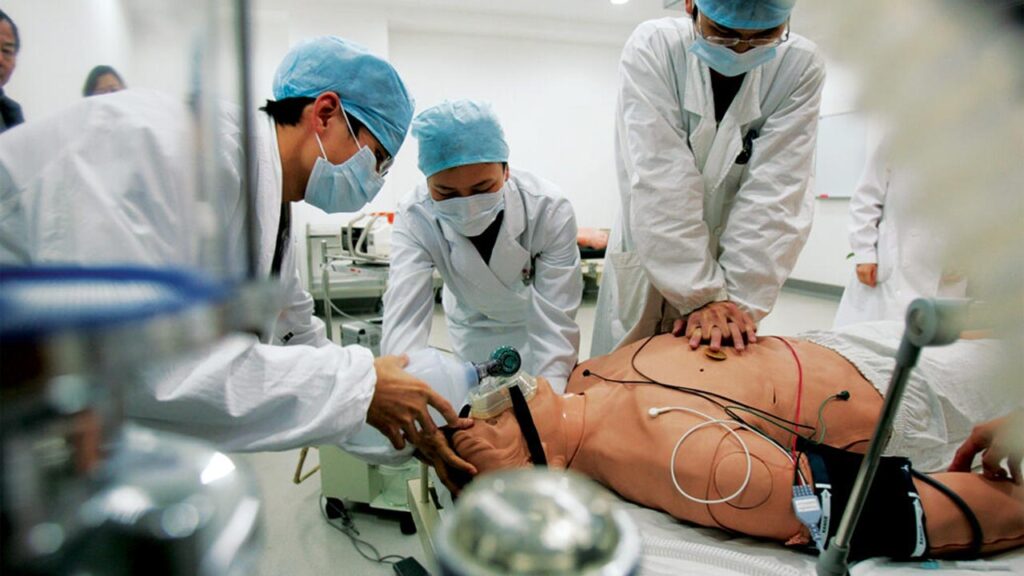
With modeled physiology, that relationship changes. Elevate Healthcare’s (formerly CAE Healthcare) Maestro simulation software uses physiological models to determine how the simulated patient responds to learner interventions. When a learner administers a medication, for example, the model accounts for the pharmacological interaction and produces a physiologically coherent response based on the patient’s current state. This creates a dynamic cause-and-effect relationship between learner decisions and patient outcomes while reducing the need for faculty to manually manage each physiological change.
For medication scenarios, the distinction has a direct impact on what learners actually practice. On a scripted platform, learners practice the procedural sequence:
Recognize the situation → select the medication → administer the medication.
On a Maestro-powered platform, learners practice the full clinical reasoning loop:
Recognize → decide → administer → reassess the physiological response → adjust.
That second loop more closely reflects what clinicians must do in real patient care.
Clinical Mistakes Learners May Make When Drug Responses Are Not Realistic
Medication simulation is most valuable when learners have an opportunity to experience the consequences of their decisions.
When a simulated medication response is predetermined, learners may develop a transactional approach to medication administration. They identify a clinical presentation, select a medication, administer it, and wait for the expected improvement.
The problem is that real patients do not always respond exactly as expected.
Medication administration errors can result from incorrect dose, timing, route, selection, or execution. Effective training can help learners recognize and prevent these errors. However, if a simulation platform does not generate dose-dependent or physiologically dependent responses, learners may primarily practice executing an action rather than managing the patient’s response to that action.
The clinical skill that ultimately transfers to patient care is not simply medication administration. It is outcome management.
Several error patterns can emerge when pharmacological realism is limited:
- Failure to reassess: Learners may not recognize the need to reassess after medication administration if the scenario does not require them to respond to a changing patient condition.
- Missed deterioration: Learners may have fewer opportunities to recognize early signs of medication-induced hemodynamic or respiratory instability.
- Fixed clinical reasoning: Learners may associate a particular presentation with a particular medication without developing the adaptability required when a patient responds differently than expected.
- Delayed intervention: Learners may not experience the consequences of waiting too long to administer an appropriate treatment.
These are not necessarily failures of knowledge. They can be failures of practice opportunity.
How Physiological Accuracy in Medication Scenarios Supports Clinical Decision-Making
The transfer from simulation to clinical practice is strongest when the simulation produces cognitive demand that mirrors real clinical conditions. Repeated practice stimulates memory mechanisms that provide effective contextual cues for subsequent clinical practice, meaning the physiological patterns learners observe in simulation become the recognition templates they use at the bedside.
For medication scenarios, that transfer is built through four specific learning experiences that physiologically accurate simulation enables, namely:
- Learners observe dose-dependent responses that teach them the relationship between intervention strength and patient response.
- Learners experience delayed onset of drug effect, which trains patience and prevents premature stacking of doses.
- Learners manage unexpected responses, building the adaptive clinical reasoning that scripted scenarios cannot produce.
- Learners practice reassessment as a clinical habit, because physiological simulation demands it.
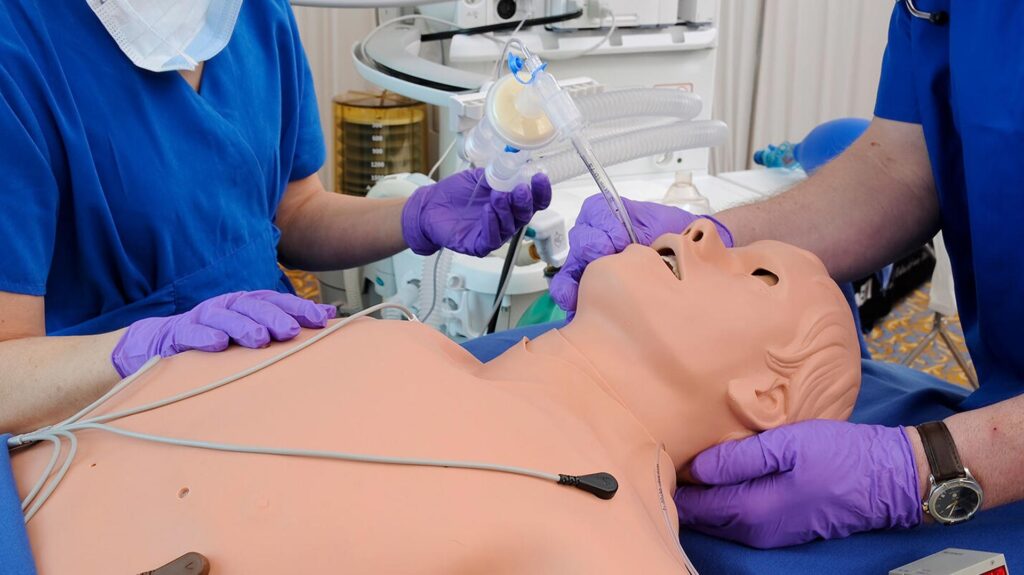
Careful scenario design and effective debriefing are critical to ensuring that learners can transfer knowledge and skills from simulation to clinical practice. For medication scenarios specifically, that design requires faculty to think beyond the procedural sequence and build scenarios that present learners with assessment moments that follow administration, not just before it.
How Faculty Should Design Medication Administration Scenarios for Maximum Learning Transfer
Scenario design for medication training on a physiologically accurate platform requires a different approach than scripted scenario construction. The learning objectives must extend beyond drug selection to include dose calculation, timing, reassessment, and response to unexpected outcomes.
Effective medication scenarios share several design features:
- Presents a clinical situation that has more than one pharmacologically reasonable response, requiring learners to make a judgment call rather than a knowledge recall.
- Includes a deterioration pathway that activates if the learner delays, underdoses, or selects an inappropriate agent.
- Includes a reassessment window after administration where the physiological response is visible and clinically meaningful.
Nurse educators should consider learner ability and complexity level when designing simulation observations to prevent overwhelming learners, especially during urgent and complex scenarios. For medication training, this means calibrating pharmacological complexity to the learner’s stage.
How Elevate Learning Institute Scenario Design Courses Help Faculty Build Effective Medication Scenarios
Elevate Healthcare supports faculty development through the Elevate Learning Institute, which offers Outcomes-Based Education Programs designed to transform team impact on healthcare safety through results-driven training. The “Simulate to Educate: Design, Lead, Debrief, Evaluate” course sits within the Simulation and Clinical Readiness track, giving faculty structured development in how to design, lead, and evaluate simulations for enhanced learning.
LearningSpace supports the debrief phase of medication scenarios through video capture and the Ehli AI-assisted debrief tool. Faculty can review the specific moment a learner administered a drug, examine the physiological response that followed, and anchor the debrief conversation in what actually happened rather than what the learner recalls.