



Blog
High-Fidelity Manikins vs. High-Fidelity Simulation: What’s the Difference?
There’s a question that comes up frequently in simulation planning conversations, especially when programs are evaluating equipment investments or building new simulation capabilities: Do we need high-fidelity manikins, or is high-fidelity simulation something different?
The short answer is that they’re related, but they’re not the same thing. Understanding that distinction can help you avoid either overspending on hardware you don’t need or underbuilding a program that can’t deliver the outcomes you’re after.
What Are High-Fidelity Manikins?
A high-fidelity manikin is a computerized, full-body patient simulator that replicates human anatomy and physiology with a high degree of realism.
It breathes. It has palpable pulses at the carotid, radial, and femoral sites. Its chest rises and falls. It produces auscultable lung and heart sounds, responds to medications with changes in heart rate and blood pressure, and can be programmed to deteriorate or improve in response to a team’s interventions.
Instructors run scenarios from a separate control station, adjusting the patient’s condition in real time by triggering ventricular fibrillation, dropping oxygen saturation, or introducing a tension pneumothorax while learners assess, decide, and act on the other side of the wall.
This is the hardware side of the equation. The manikin is the physical patient.
What Is High-Fidelity Simulation?
High-fidelity simulation is broader. It refers to the entire simulation-based learning experience, not just the physical device. It includes the scenario design, environmental setup, facilitation approach, and, critically, the structured debrief that follows.
The manikin is one component of a high-fidelity simulation. A well-constructed learning environment around it is what makes the experience educationally powerful.
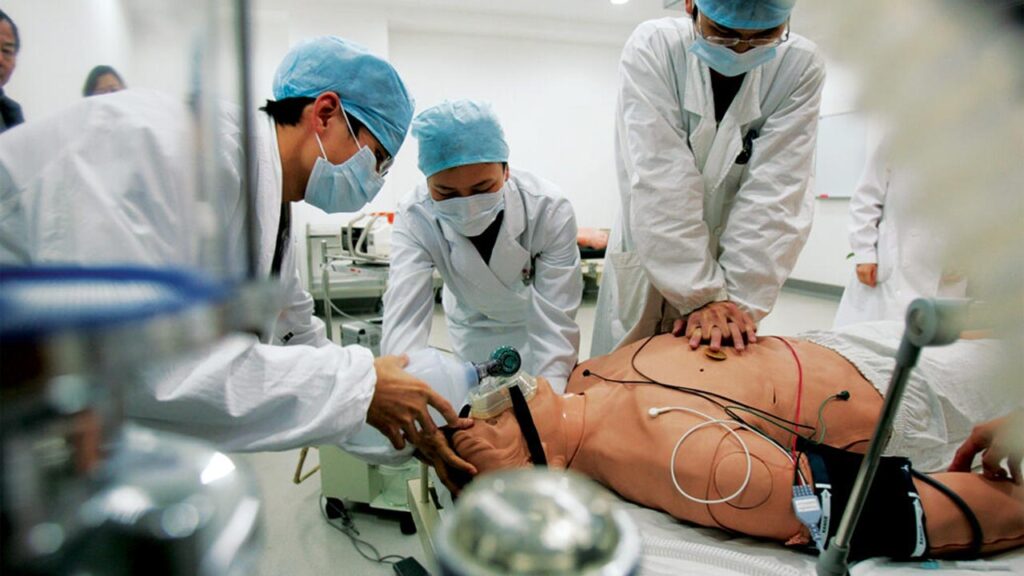
Think of it this way: you can place a high-fidelity manikin in a room, run a scenario, and walk away. That’s hardware utilization.
High-fidelity simulation means the scenario was built around a specific learning objective, the team’s performance was observed and captured, and a skilled facilitator guided a structured debrief that connected what happened in the room to what needs to happen at the bedside.
That’s education.
This is why the quality of the debrief matters as much as the quality of the manikin. The evidence on simulation-based learning is consistent: the debrief is where learning consolidates.
A technically sophisticated simulator paired with a weak debrief will often underperform a mid-fidelity manikin used by a skilled facilitator who knows how to guide meaningful reflection and discussion.
When Is High Fidelity Truly Necessary?
Not every learning objective requires a high-fidelity manikin. That’s not a criticism of the technology, but a case for using it strategically.
High fidelity earns its place when the learning goal requires physiological realism, dynamic scenario progression, or interprofessional team response. Some specific situations where it genuinely matters include:
High-acuity, low-frequency events. Postpartum hemorrhage. Septic shock. Malignant hyperthermia. Pediatric respiratory arrest. These are the scenarios where teams need to be sharp precisely because they don’t encounter them routinely. A high-fidelity simulator lets you recreate the clinical pressure, like the deteriorating vitals, the time constraint, and the communication demands, in a way that a static or mid-fidelity device simply cannot.
Team training and crisis resource management. When the goal is to observe and improve how a team communicates, assigns roles, and makes decisions under pressure, you need an environment that creates genuine clinical urgency. High-fidelity manikins generate that urgency in a way that engages even experienced clinicians.
Competency assessment. When simulation is being used to evaluate clinical readiness for new graduate nurses, for residents completing a procedural milestone, or for teams validating a new protocol, the reliability of the physiological response matters. Assessors need consistent, repeatable scenarios, and high-fidelity systems deliver that.
A task trainer or mid-fidelity manikin remains the better choice for isolated procedural skills. Learning to place a central line or manage a difficult airway for the first time doesn’t require a full physiological model. It requires realistic anatomy and tactile feedback. Matching fidelity to the objective isn’t a compromise. It’s a good program design.
The Cost and Complexity Trade-offs
High-fidelity manikins represent a significant investment, and the conversation should include more than the purchase price.
Consumables such as replacement skin, lungs, and IV arms add up over time. Software licensing, maintenance contracts, and the faculty development required to run scenarios and debrief effectively are all part of the total cost of ownership.
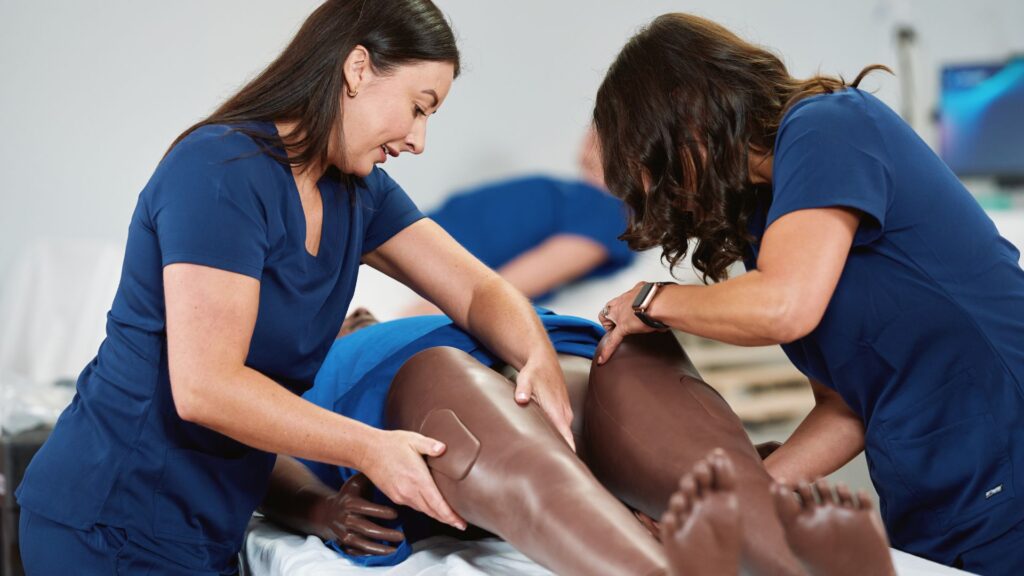
That’s not an argument against investing. It’s an argument for investing intentionally.
Programs that see the strongest return on high-fidelity simulation treat it as a complete system: the right simulator, connected to a platform that captures and organizes performance data, and supported by educators who know how to design scenarios and facilitate effective debriefs.
The Practical Takeaway
High-fidelity manikins and high-fidelity simulation are not interchangeable terms.
The manikin is the tool. The simulation is the educational experience built around it.
Both matter, and neither works particularly well without the other.
When evaluating whether your program needs to move up the fidelity spectrum, start with your learning objectives and your highest-risk scenarios.
If your teams need to train for situations where physiology, urgency, and team communication all come together under pressure, that’s the case for high fidelity.
Pair the right simulator with strong scenario design, skilled facilitation, and structured debriefing, and you’ve built something that can meaningfully improve clinical performance.
Building Your High-Fidelity Program with Elevate Healthcare
Elevate Healthcare offers high-fidelity simulators designed to support a wide range of healthcare training environments and populations.
The portfolio includes:
- Ares for emergency and prehospital care
- Juno for clinical skills training and patient assessment
- Lucina for obstetric simulation, labor and delivery training, and fetal monitoring
- Aria for pediatric emergency training
- Human Patient Simulator (HPS) for advanced adult physiological simulation
What ties these solutions together is LearningSpace, Elevate Healthcare’s simulation management and debriefing platform.
LearningSpace helps:
- Capture simulation sessions in real time
- Support structured debriefing and learner reflection
- Organize performance data and outcomes
- Support accreditation, quality reporting, and program evaluation initiatives
Together, simulators, software, and educator support create a connected ecosystem designed to help programs improve learner performance and clinical readiness.
If you’re evaluating high-fidelity simulation solutions for your program, start by identifying the learning objectives, clinical scenarios, and operational requirements that matter most. From there, you can determine the right combination of simulators, software, and support to meet those goals.
The Bottom Line
High-fidelity manikins and high-fidelity simulation serve different—but equally important—roles in healthcare education.
The manikin provides physiological realism. The simulation experience provides the context, reflection, and learning that drive performance improvement.
When technology, instructional design, and debriefing work together, simulation becomes far more than a training exercise, it becomes a powerful tool for preparing healthcare teams for real-world patient care.