


Blog
The Principles of Simulation in Healthcare: What Every Educator Should Know
Great simulation sessions rarely happen by accident. Behind every effective scenario sits a set of principles that guide design, facilitation, and evaluation. Simulation in healthcare works best when those principles are applied consistently.
Shared principles also give programs a common language. Faculty can align on what quality looks like, and learners receive a more predictable experience. This guide covers the core principles, the standards behind them, and how to put them into practice.
What Are the Principles of Simulation in Healthcare?
The principles of simulation in healthcare describe how to design and deliver experiences that produce meaningful learning. They center on clear objectives, psychological safety, purposeful design, skilled facilitation, and structured reflection. Each principle supports the others, so weak execution in one area can affect the success of the scenario.
Learner-centered design sits at the heart of these principles. Every decision, from scenario complexity to equipment choice, should serve the learner’s objectives. Educators who start with the learner rather than the technology tend to run more focused sessions.
Psychological safety is equally essential. Learners need to feel free to make mistakes, ask questions, and reflect honestly without fear of judgment. Educators build that safety through clear ground rules, respectful facilitation, and transparent assessment.
What Principles Does INACSL Define for Simulation-Based Learning?
The International Nursing Association for Clinical Simulation and Learning (INACSL) publishes a leading framework for this work. The INACSL Healthcare Simulation Standards of Best Practice include ten standards covering the full simulation process. They address professional development, prebriefing, simulation design, facilitation, debriefing, operations, and outcomes and objectives.
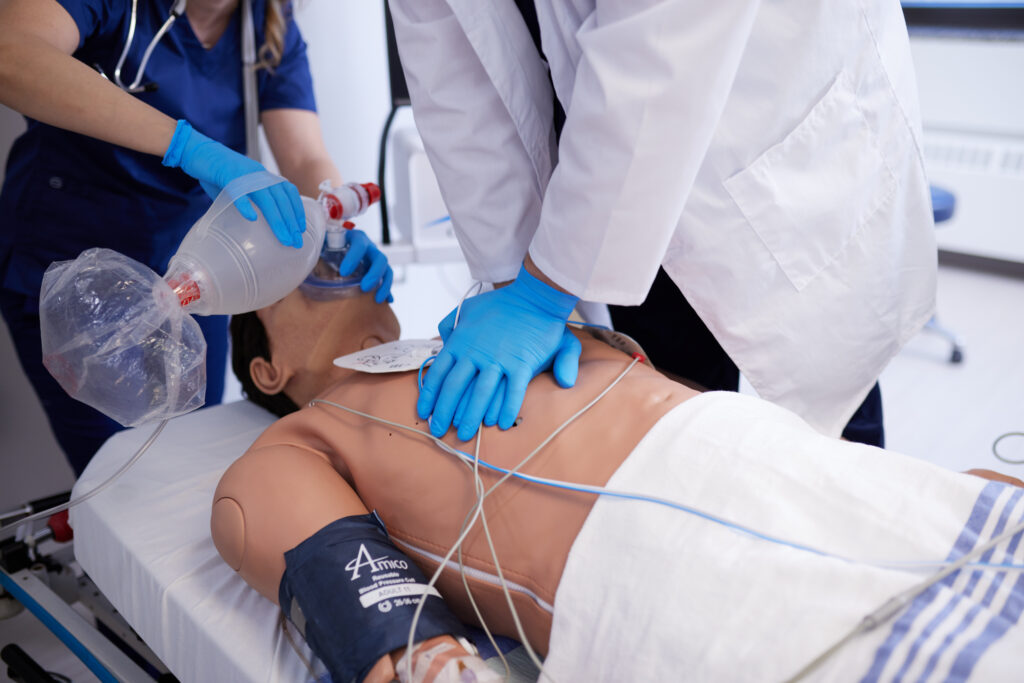
The remaining standards cover professional integrity, simulation-enhanced interprofessional education, and evaluation of learning and performance. INACSL released a fourth edition in 2025 that revised four cornerstone standards. These updates focus on prebriefing, facilitation, debriefing, and professional integrity.
Many programs use these standards as a quality blueprint. The framework gives faculty clear criteria for planning, running, and evaluating simulation-based experiences. It also provides a consistent benchmark for programs to review their practices over time.
How Do Fidelity, Debriefing, and Learner Outcomes Connect?
Fidelity describes how closely a simulation reflects real clinical conditions. It includes physical realism, such as a simulator’s appearance and functionality, and psychological realism, such as the pressure of a crisis.
A new learner practicing a basic assessment may need only a simple task trainer. An experienced team rehearsing a massive hemorrhage may need a high-fidelity simulator with dynamic vital signs. The right match helps keep cognitive load manageable and learning goals within reach.
Debriefing connects the experience to lasting outcomes. The 2025 INACSL debriefing standard states that every simulation-based activity must include a planned debriefing process. Platforms like Elevate Healthcare’s (formerly CAE Healthcare) LearningSpace help programs support consistent debriefing through video review, structured assessment, and centralized session records.
Outcomes complete the loop. Programs should measure whether learners met the objectives each scenario targeted. Those results can then guide revisions to scenarios, facilitation, and curriculum, helping programs strengthen learning and support better patient care.
What Makes a Scenario Educationally Sound?
An educationally sound scenario begins with measurable objectives. Each objective should describe a specific behavior the learner can demonstrate, such as recognizing early signs of sepsis. Clear objectives guide every other design choice and make evaluation easier.
Strong scenarios also include a realistic patient story, planned physiological changes, and defined decision points. Designers should anticipate likely learner actions and plan how the case will respond to each one. A pilot run with faculty helps uncover gaps before learners experience the scenario.
Prebriefing sets the stage for success. Learners should understand the objectives, the environment, and the ground rules before the scenario begins. Good preparation reduces anxiety and helps learners focus on clinical reasoning instead of logistics.
Every scenario also needs a review cycle. Faculty should revisit scenarios after each run and update them based on learner performance and feedback. This habit helps keep content current, clinically accurate, and aligned with evolving practice.
How Should Faculty Apply the Principles of Simulation in Healthcare?
Faculty turn principles into practice through deliberate, repeatable habits. They prepare thoroughly, facilitate with intention, and debrief using a consistent model. Consistency across instructors helps provide every learner with a high-quality experience.
Facilitation requires real skill. Educators must know when to let learners struggle productively and when to offer cues. The right approach depends on learner needs and expected outcomes.
Debriefing demands the same level of preparation. Faculty should choose a structured model, guide reflection with open questions, and connect insights to future practice. Resources on debriefing best practices can help faculty refine these skills over time.

Ongoing professional development keeps these skills sharp. Educators benefit from formal training in scenario design, facilitation, and debriefing methods. Programs through Elevate Learning Institute give faculty practical, expert-led instruction to help them apply these simulation principles in their daily work.
How Do the Principles of Simulation in Healthcare Connect to Accreditation?
Accrediting bodies look for evidence that programs follow sound simulation principles. Society for Simulation in Healthcare (SSH) accreditation, for example, reviews program quality across areas such as teaching, assessment, and core operations. Programs that already follow recognized standards may find the review process easier to manage.
Documentation plays a major role in accreditation readiness. Reviewers may look for scenario templates, debriefing records, facilitator training, and outcome data. Programs that capture this information consistently can demonstrate their practices rather than simply describe them.
Program design matters as much as documentation. Strategic consulting through Elevate Healthcare’s Achieve Program helps teams identify gaps and align their practices with clinical goals and standards. That preparation can build a stronger foundation for any accreditation effort a program pursues.
Put the Principles of Simulation in Healthcare into Practice
Strong principles only create value when programs apply them every day. Elevate Healthcare connects these foundational ideas to practical tools and support. Its solutions help faculty design sound scenarios, debrief consistently, and measure learning outcomes.
Elevate Healthcare’s patient simulators run on Maestro software, which supports responsive physiology that educators can align with each scenario’s objectives. Ultrasound simulators give learners guided, repeatable practice in image acquisition and interpretation. Task trainers and accessories support focused skill-building when a scenario calls for lower fidelity.
LearningSpace supports debriefing and documentation, while Elevate Learning Institute and the Achieve Program strengthen faculty skills and program design. Together, these solutions help programs align with recognized standards and prepare for accreditation with confidence.
Turn healthcare simulation principles into lasting results. Connect with a simulation expert today.