



Blog
Staffing Shortages in Healthcare: How Simulation Can Support Nurse Retention and Workforce Development
The numbers behind the current nursing crisis are significant, but hospital leaders already know the numbers. What matters now is what health systems can actually control. Staffing shortages in healthcare are driven by forces that no single organization can reverse, including an aging population, retiring nurses, and nursing school capacity constraints that take years to address. However, hospitals can influence how prepared new nurses are when they arrive, how supported they feel during the first year, and whether the organization’s development infrastructure gives people a reason to stay.
Simulation-based training has a documented role in each of these areas. It won’t solve the nursing pipeline challenge on its own, but it can strengthen an organization’s response by improving readiness, supporting workforce development, and helping new nurses transition into practice with greater confidence.
What Is Driving Current Nursing Staffing Shortages in Healthcare?
The current shortage is structural. The U.S. Bureau of Labor Statistics projects more than 193,000 registered nurse openings each year through 2032, driven by workforce turnover and growing demand from aging populations. In other words, this annual gap is not a temporary disruption. It is the baseline condition that health systems must plan around.
Several forces compound the challenge. The National Council of State Boards of Nursing (NCSBN) has reported that more than 138,000 nurses exited the workforce since 2022, and nearly 40% intend to leave by 2029. Meanwhile, nursing schools are not expanding quickly enough to replace departing nurses. Burnout, inadequate staffing ratios, and limited professional development opportunities further accelerate the loss of nurses who are already in the workforce.
The nurses who leave during the first year are among the most expensive to replace. Hospitals now spend more than $60,000 to replace a single registered nurse, a cost that compounds quickly for organizations experiencing high early-tenure turnover. As a result, the first 90 days of a new nurse’s career are where that investment is most at risk. Nurses who feel underprepared, unsupported, or disconnected from their team are far more likely to leave before the organization has realized any return on its hiring and onboarding investment.
This is where hospital education leaders have the greatest opportunity to make an impact. Simulation-based training addresses the readiness and confidence gap that contributes to early turnover while generating measurable, well-documented outcomes.
How Effective Onboarding With Simulation Affects Early Turnover
Preparedness and belonging are two of the strongest predictors of new nurse retention during the first year. Nurses who feel clinically ready and professionally supported are more likely to stay. Simulation-based onboarding helps strengthen both.
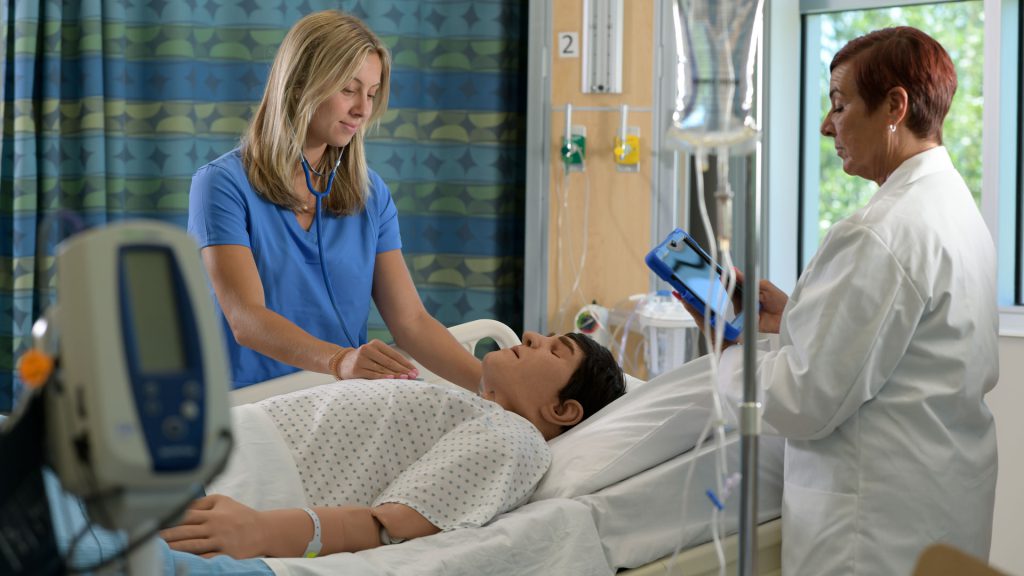
Before participating in full simulation scenarios, many onboarding programs begin with task trainers that allow new nurses to build proficiency in individual clinical skills. For example, task trainers can be used to practice IV insertions, injections, catheterization, and other hands-on procedures in a focused, low-pressure environment. By developing confidence with these foundational skills first, nurses are better prepared to participate in more complex simulation exercises.
High-fidelity scenario practice before the first real patient encounter builds clinical confidence in a way that preceptor shadowing alone cannot replicate. New nurses who have already managed a simulated sepsis event, a deteriorating patient, or a complex medication scenario bring a different level of readiness into their first shifts. That increased confidence is noticeable to the nurse, the preceptor, and the rest of the care team.
As nurses gain confidence, onboarding can progress from foundational skills practice to increasingly complex simulation scenarios that integrate clinical decision-making, communication, and teamwork. This staged approach helps learners build competence step by step before caring for patients independently.
Structured debriefing provides the second critical element. A new nurse who receives direct, specific, and non-punitive feedback on clinical decision-making learns faster and feels more supported. Equally important, they develop the psychological safety to ask for help on the unit, one of the strongest protective behaviors during the first year.
Research on simulation-based emergency training for novice critical care nurses found that simulation enhances clinical skills and confidence while complementing traditional training methods. Together, these approaches can strengthen workforce development and help new nurses transition into practice more successfully.
The key is structure and consistency. A simulation-based onboarding program that delivers the same progression, beginning with task trainers, advancing through low- and high-fidelity simulation, following the same debriefing framework, and generating consistent performance documentation for every new hire cohort, creates a repeatable learning experience. That consistency benefits individual nurses while also making program-level evaluation far more meaningful.
Workforce Development Programs That Incorporate Simulation Most Effectively
Simulation’s workforce development value extends well beyond onboarding. Nurse residency programs, clinical ladder advancement initiatives, and ongoing competency verification all benefit from simulation infrastructure that supports practice, assessment, and documentation.
The programs that incorporate simulation most effectively share several design characteristics. They use simulation for both skill development and performance evaluation, not as a reward or occasional event, but as a routine part of clinical growth. They also tie simulation activities to career advancement milestones, giving nurses a professional reason to participate. Finally, they generate data that remains in a learner’s record over time, building a competency profile that follows the nurse throughout each stage of their career.
Research has shown that structured onboarding programs can reduce clinical errors, improve multidisciplinary collaboration, and enhance the patient experience. Building on that foundation, simulation-supported workforce development programs extend learning beyond orientation by introducing progressively more complex scenarios, leadership development exercises, and interdisciplinary team training throughout a nurse’s career.
How Hospital Education Leaders Can Build a Business Case for Simulation
The business case for simulation as a workforce development tool begins by comparing program cost with replacement cost. If replacing one nurse costs $60,000 or more, even modest improvements in first-year retention can significantly offset the investment in a structured simulation program before patient safety outcomes are even considered.

The strongest business case is built on institutional data rather than industry averages. Hospital education leaders should document early turnover rates before and after implementing structured simulation programs. Likewise, they should track time to competency for new hire cohorts while capturing performance data through their simulation platform to demonstrate measurable program outcomes.
Research has found a connection between lower turnover and investment in training and workforce development in healthcare. However, the most persuasive business cases combine that evidence with local program data. A simulation platform that produces aggregate performance reports, records scenario outcomes, and tracks learner progress over time provides education leaders with the documentation needed to demonstrate value to institutional leadership and finance teams.
That documentation layer is more than an administrative benefit. It is what transforms a simulation program from a training expense into a long-term workforce strategy.
Solve Staffing Shortages in Healthcare
Elevate Healthcare (formerly CAE Healthcare) provides simulation solutions that support workforce development across the continuum of clinical practice. Its portfolio of adult, critical care, obstetric, neonatal, and pediatric simulators gives hospital education teams the flexibility to support onboarding, competency maintenance, and advanced clinical development within a connected ecosystem. Complementing that hardware, LearningSpace provides the recording, debriefing, assessment, and performance documentation capabilities that help transform simulation activities into meaningful institutional data.
For workforce leaders making the case that simulation supports staffing stability, this combination matters. A program built on Elevate Healthcare’s ecosystem can document what new nurses practiced, how they performed, how their competencies developed over time, and how that development connects to the clinical quality and retention outcomes the organization is working toward.
Whether you’re expanding an existing simulation program or building a new workforce development strategy, Elevate Healthcare’s simulation specialists can help identify the right combination of simulators, software, and educational services to support your goals. Connect with a simulation specialist to learn more.