



Blog
From Fidelity to Workforce Readiness: Insights from Elevate Healthcare CEO Brian Truesdale at IMSH 2026
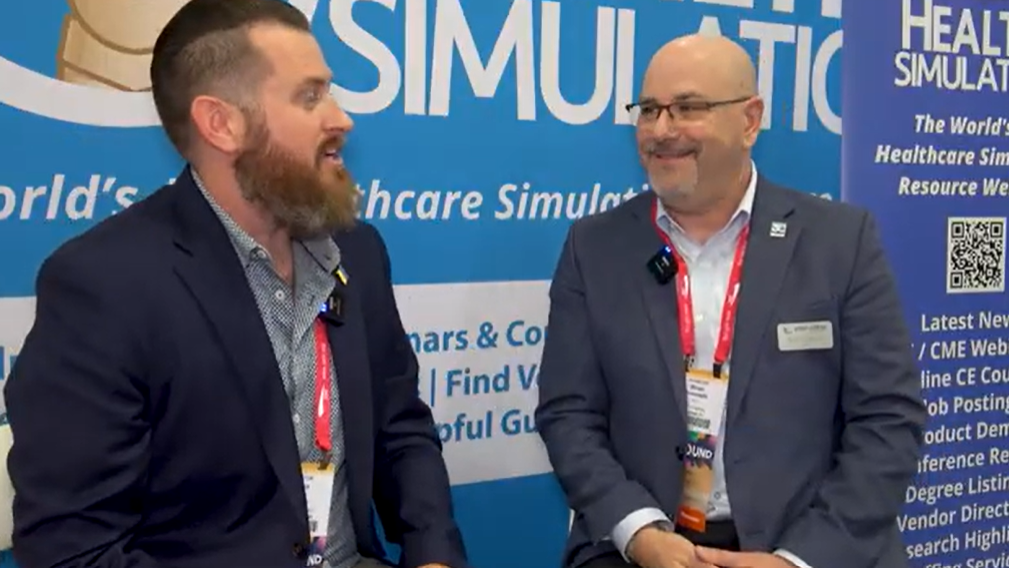
“We’re always outcome driven in what we try to innovate. By being outcome first, we actually solve from the end answer you’re looking for back into the technologies we need to apply.”
– Brian Truesdale, CEO, Elevate Healthcare
Brian Truesdale emphasizes that healthcare education is advancing beyond a focus on realism alone.
In a conversation at IMSH 2026 with HealthySimulation.com, Brian described a clear shift in how innovation must be approached, starting not with tools, but with clearly defined performance goals and outcomes.
For years, simulation innovation focused on increasing realism. More lifelike manikins. More realistic physiology. More immersive environments.
That evolution was necessary. It built the foundation.
Now the challenge is shifting.
From High Fidelity to High Impact
The pressure facing healthcare education today isn’t just how real a scenario looks. According to Brian, the real test is how effectively simulation prepares learners for practice. Realism alone can’t solve the bigger challenge: supporting learner competency at scale.
That challenge is compounded by real-world constraints. There are shortages not only in nurses and physicians, but also in faculty. Educators are stretched thin, balancing growing administrative demands, documentation requirements, and expectations for timely, actionable feedback.
As Brian noted in his interview, one of the most significant opportunities ahead is removing “task work” from educators so they can focus on the work that truly matters: guiding learners, coaching skills, and reinforcing performance.
The question is no longer:
How real does it look?
The question is:
How efficiently does it move learners toward competency?
This shift represents a move from high-fidelity as a benchmark to high impact as the true measure of success.
AI Supports Readiness, Keeps Faculty in the Loop
Artificial intelligence plays a critical role in this shift, but it is not meant to replace human expertise.
AI-supported evaluation solutions can:
- Reduce hours of video review to minutes
- Deliver feedback within hours instead of weeks
- Provide structured scoring support
In a case study with the University of Alabama at Birmingham (UAB) Office of Standardized Patient Education, AI-assisted transcript review was evaluated as a decision-support tool for checklist quality assurance. The study illustrated how faculty can remain firmly “in the loop” while automation handles the scoring and evaluation workload.
LearningSpace AI Assistant, Ehli, leverages intelligent automation to handle these repetitive evaluation tasks. Ehli delivers consistent, reliable results across learners and sessions, helping simulation centers use time and resources more efficiently while supporting high-quality learner outcomes. AI alone is only part of the story, these tools are most effective when integrated into a connected, comprehensive simulation ecosystem.
Moving Beyond Isolated Solutions
Simulation does not operate in isolation. It must align physical experiences, digital management platforms, data capture, and competency frameworks into a cohesive ecosystem.
When these elements work together, feedback becomes faster. Data becomes actionable. Programs gain clearer visibility into learner progression.
Integration strengthens defensibility, improves operational efficiency, and better positions simulation programs to demonstrate their value to academic and health system leadership.
Closing the Gap Between Education and Practice
Healthcare organizations expect graduates who can transition seamlessly into clinical roles. Academic institutions are under pressure to ensure learners are prepared not just academically, but operationally.
Simulation centers are designed to mirror real clinical environments, and curriculum is tied to workforce expectations.
The result is a narrowing gap between classroom learning and clinical performance.
Readiness is increasingly expected by healthcare organizations.
Simulation is the bridge that makes it achievable.
The Opportunity Ahead
With these insights in mind, Brian emphasized the next question for simulation programs: how can simulation continue evolving to meet the demands of the future?
Throughout the conversation, Brian returned to a consistent theme: start with outcomes and work backwards.
Innovation in simulation is not about adding complexity. It is about enabling better results.
As outcome-driven design continues to shape innovation, simulation will evolve from a powerful educational tool into something more strategic – a driver of measurable workforce preparedness.
The institutions that embrace this mindset will be positioned not just to keep pace with change, but to lead it.
Watch the full conversation below.