



Blog
Advancing Military Medical Readiness Through Simulation
Effective readiness requires training that reflects the realities teams may face in the field.
As emergency response and battlefield conditions evolve, training must evolve with them. For military medical teams, that means preparing for complex and unpredictable situations across the continuum of care.
Through its Strategic Accounts team, Elevate Healthcare supported a high-fidelity mass casualty exercise with R2 Medical Group, a military medical contractor, and the 1st Cavalry Division, U.S. Army.
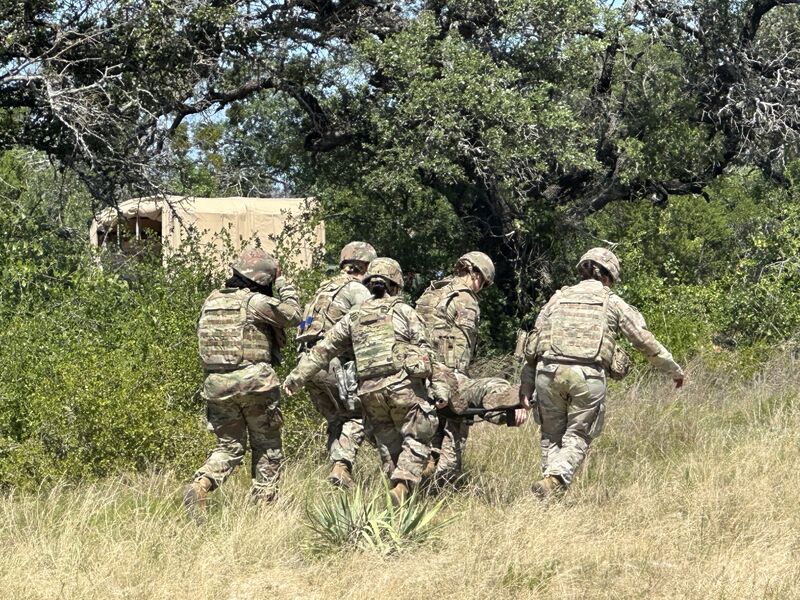
The exercises took place at Fort Hood, involving Army combat medics and support personnel, with scenarios involving up to 29 simultaneous casualties. Participants worked from Point of Injury (POI) through Role 2, where casualties receive more advanced care, while responding to threats including simulated .50-cal fire, drone strikes and improvised explosive device (IED) attacks.
Preparing for the Complexity of Modern Emergencies
A mass casualty event is not a harder version of a single-patient call. It is a different problem: triage under pressure, competing priorities, and constant movement of patients between points of care.
Running up to 29 casualties in a single scenario put teams in a situation that demanded that level of coordination. Participants had to operate across multiple points of care simultaneously, making treatment decisions while casualties moved through different points of care.
The drone and IED conditions added a second dimension.
As the nature of conflict changes, so do the threat conditions medical teams may encounter. Building those into the scenarios meant participants were not only treating wounds, but treating them in an environment that could turn.
How the Exercises Were Built
Elevate Healthcare provided Apollo patient simulators and supporting simulation resources across the training environment, helping create realistic patient encounters within the mass casualty scenarios.
Why High-Fidelity Simulation Fits This Problem
High-fidelity simulation brings realistic patient conditions, operational pressure, and clinical decision-making together in an environment where all three can be observed and adjusted.
For military medical training, that shifts the focus from isolated skills to how care actually unfolds.
Training from Point of Injury through Role 2 meant participants had to manage handoffs, communication, and continuity of care as casualties moved through different levels of treatment.
It also made structured debriefing possible.
Teams could examine how they performed when multiple casualties, clinical demands, and operational threats converged at once.
Readiness Starts Before the Emergency
The distance between knowing a protocol and having worked the problem is where readiness actually lives, and it closes through repetition in conditions demanding enough to expose what may not hold up: a triage decision made too slowly, a handoff that loses information, or a plan built around one casualty instead of twenty-nine.
Exercises like these exist to surface those gaps while the consequences are still recoverable.
Elevate Healthcare partners with military and healthcare organizations to build training environments at that level of demand.
Because when the stakes are real, readiness begins long before the emergency happens.