



Customer Stories
Where practice becomes readiness

Customer Story · Carolinas Simulation Center
How Carolinas Simulation Center reaches across Atrium Health’s Greater Charlotte area—bringing high-quality simulation closer to the teams who need it.
From a small founding team to a connected simulation operation serving Atrium Health’s Greater Charlotte area, Carolinas Simulation Center is creating more opportunities for healthcare teams to practice together before the stakes are real.
A postpartum hemorrhage. An unexpected delivery. A newborn who needs urgent support.
These moments may be rare, but when they happen, healthcare teams must be ready to respond together. That readiness cannot depend on whether a team works near a simulation center.
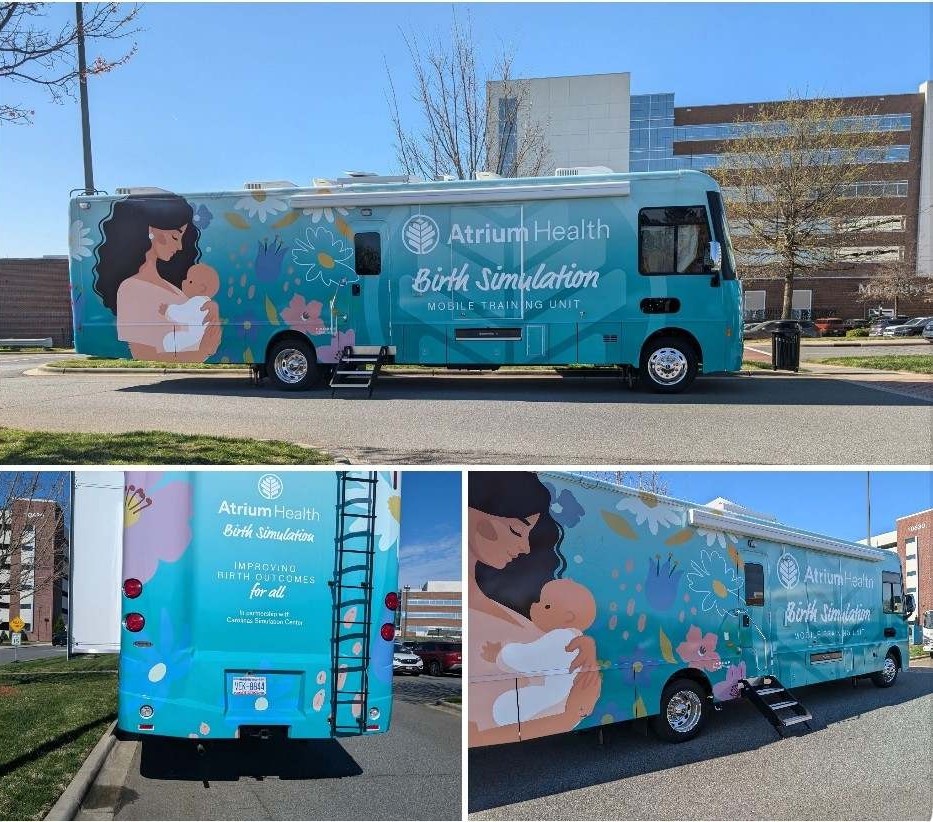
Across Atrium Health’s Greater Charlotte area, birth centers vary in size, staffing, and distance from the city. Some are more than an hour away. The Women’s Division’s mobile maternal and newborn simulation vehicle, in collaboration with Carolinas Simulation Center, brings structured practice directly to those teams, giving them opportunities to rehearse high-stakes emergencies, strengthen coordination, and reflect together before they face those moments in patient care.
“It’s a prime example of our focus on getting our healthcare teams trained. We want to make sure that we’re giving the resources and allowing the practice and the reps that people need.”
Crystal Bencken · Simulation Education Manager, Carolinas Simulation Center
The mobile program is one of the most visible expressions of a much larger story. Since its founding in 2007, the Center has grown from a small team into a broad simulation operation capable of supporting learners, clinical teams, and system priorities across locations and throughout the healthcare continuum.
How Carolinas Simulation Center grew into a health system partner
When Dawn Swiderski became Carolinas Simulation Center’s founding leader in 2007, the program had just 1.5 employees and operated from a small location. Today, it has nearly 40 team members at full staffing and a presence across multiple locations.
2007
Year the Center was founded
Nearly 40
Team members at full staffing
5 areas
SSH accreditation categories
That growth has depended on people who can turn new ideas and organizational needs into working programs. Simulation Education Managers Crystal Bencken and Jennifer Noble—whom Swiderski calls the Center’s “dynamic duo”—oversee its day-to-day operations and the educational content delivered across its spaces.
All three leaders came to simulation through nursing, clinical practice, and education. Those experiences continue to shape how they approach the work: not as technology or training for its own sake, but as a way to help healthcare teammates practice together, strengthen their readiness, and provide better care.
That purpose extends across the Center’s educators, operations specialists, technology professionals, researchers, and support staff. Each contributes a different kind of expertise, but the team shares a belief that its work ultimately supports patient safety and quality of care.
As the team has grown, so has the range of people and priorities it supports. The Center reaches learners from their earliest exposure to healthcare careers through pre-licensure education, transition to practice, and ongoing clinical competency. Its work spans medical education, nursing, clinical practice, health informatics, organ donation, family-support coordination, spiritual care, environmental services, systems testing, and other areas of the health system.
“If you are part of the Greater Charlotte area, we serve you.”
Crystal Bencken · Simulation Education Manager, Carolinas Simulation Center
The Center has maintained a strong commitment to quality throughout that expansion. It is accredited by the Society for Simulation in Healthcare in Assessment, Research, Teaching/Education, Systems Integration, and Human Simulation. It is also accredited by the American College of Surgeons as a Comprehensive Education Institute.
For the team, those accreditations reflect a culture that has shaped the program from its earliest years.
“It’s not just that we do sim, but we do it to best practices in all of the ways.”
Jennifer Noble · Simulation Education Manager, Carolinas Simulation Center
Mobile simulation for maternal and newborn emergency readiness
The mobile maternal and newborn simulation program was made possible by a generous gift from the C.D. Spangler Foundation and a partnership among Atrium Health Women’s Services, Atrium Health Levine Children’s Hospital, Mobile Medicine, and Carolinas Simulation Center.
Each group brought a different piece of what the program required: a commitment to maternal and newborn care, clinical knowledge, simulation expertise, and the operational capability to put a specialized vehicle on the road.
“They’re really good at birthing babies, and we’re really good at sim. So, how about we partner?”
Crystal Bencken · Simulation Education Manager, Carolinas Simulation Center
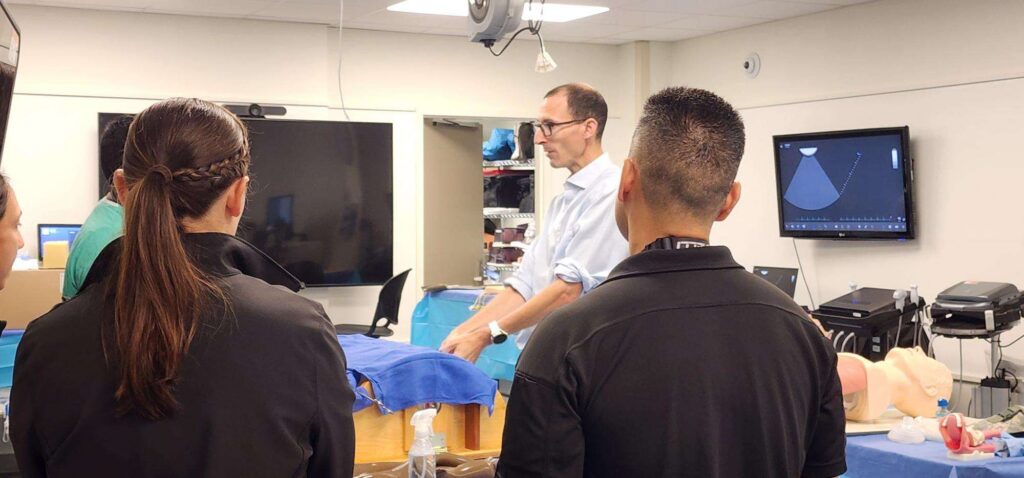
The Center helped shape the learning environment, develop the curriculum, incorporate space for debriefing, and coordinate the program across the region. The vehicle began traveling in 2025 and was designed to reach ten birth centers throughout the Greater Charlotte area.
Since then, it has given maternal and newborn teams a place to practice emergencies that require people from different roles to communicate, make decisions, and act as one team.
That practice can also reveal issues beyond individual or team performance. During one simulation, a participating site recognized that its postpartum-hemorrhage cart was not ideally located for an overnight emergency. The concern was documented and shared with leaders who could address it—an example of how simulation can uncover equipment, workflow, and environmental gaps before they affect real care.
The experience is also helping the Center think about where simulation needs to go next.
The team is preparing to extend its maternal and newborn training to freestanding emergency departments and facilities without maternal backup. These locations may not routinely provide delivery care, but an unexpected birth can still arrive at their doors.
The vehicle will remain focused on maternal and newborn emergencies, but the approach behind it has broader implications. It demonstrates how the Center can combine its expertise with that of clinical and operational partners to reach teams that may be far from a simulation center—or may not have previously viewed simulation as something available to them.
Scaling healthcare simulation without sacrificing quality
The Center scales its work by pairing simulation specialists with clinical subject-matter experts. It’s a model that helps the Center address an ongoing question:
“How do you make sure you’re impacting all of your healthcare system in a scalable approach, but not giving up your quality?”
Jennifer Noble · Simulation Education Manager, Carolinas Simulation Center
Clinical subject-matter experts bring their understanding of patient care, workflow, and the realities teams face. The Center brings expertise in simulation education, operations, scenario design, technology, facilitation, observation, and debriefing.
Swiderski describes the approach as a triad model. A subject-matter expert does not have to become a simulation technology specialist before contributing to an initiative. The simulation team can mentor that expert and translate the clinical need into a structured learning experience.
That combination of expertise has helped the Center expand into areas that may not have historically used simulation. It also allows the team to support larger system priorities, including testing new clinical environments and building curriculum for the Wake Forest University School of Medicine Charlotte campus.
The Center’s role is not simply to provide a space or piece of equipment. Its people help partners determine how simulation can address an educational, clinical, or operational need—and then build an experience around it.
How LearningSpace connects simulation across locations
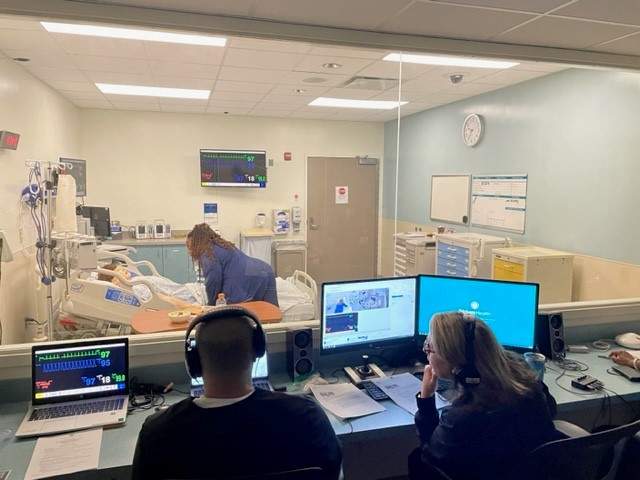
As Carolinas Simulation Center has expanded, LearningSpace has helped connect the work taking place across its distributed locations. The Center uses the platform at its main site, Cabarrus location, School of Medicine site, and inside the mobile maternal and newborn simulation vehicle.
It supports video, observation, broadcasting, and virtual delivery, allowing learners and facilitators to participate in ways that are not limited to one room or building.
“We have it in all of our locations. It also helps us tie all of our places together. Even our sim bus has it.”
Jennifer Noble · Simulation Education Manager, Carolinas Simulation Center
That capability became especially important during COVID-19. Soon after the Center moved into a larger facility equipped with LearningSpace, the team could no longer gather in the new space. At the same time, Atrium Health needed to prepare nurses for a potential surge in COVID-19 patients.
The Center used its audiovisual capabilities to create training, deliver it virtually, and reach learners who could not be physically present. The same infrastructure continues to extend the reach of the Center’s work today.
LearningSpace also supports the observer role, allowing people outside the active scenario to watch how a team responds, follow its decisions, and participate in the learning that follows.
“It’s vital for us to not just have people in the room, but to have the observer role.”
Jennifer Noble · Simulation Education Manager, Carolinas Simulation Center
For a Center working across multiple locations, that shared infrastructure helps maintain connection as the program grows. The mobile vehicle does not operate as an isolated classroom on wheels; it remains part of the larger simulation operation.
How simulation prepares healthcare teams for high-stakes moments
For Bencken, the reach of that work is personal.
“In my previous role, I could impact five patients a day. In my current role, I can literally impact hundreds of patients a day by training up really good healthcare teammates.”
Crystal Bencken · Simulation Education Manager, Carolinas Simulation Center
That belief is at the core of the Center’s growth. The goal is not growth for its own sake. It is to give more people the opportunity to practice, to help more teams prepare together, and to apply simulation expertise wherever it can support safer, higher-quality care.
The mobile maternal and newborn simulation vehicle makes that purpose visible during Healthcare Simulation Week. It brings practice closer to the teams who need it while showing what can happen when simulation, clinical, and operational partners work toward the same goal.
Sometimes that practice prepares a team to move together during a maternal or newborn emergency. Sometimes it reveals that a critical piece of equipment needs to be moved before the next overnight shift.
Both are part of readiness—and both are more valuable when discovered before the stakes are real.
Center at a glance
Organization
Advocate Health
Location
Charlotte, North Carolina
Annual learners supported
2,500+
Center scale
Large simulation operation with 6+ simulation rooms and more than 20 staff
Focus areas
Clinical skills training · Interprofessional education · Patient safety and quality improvement · Research · Simulation operations and technology
Impact areas
Learner skill development · Teamwork and collaboration · Patient safety outcomes
Explore more
Flip a card to continue exploring Elevate Healthcare resources.
REAL-WORLD PRACTICE
Customer Stories
See how simulation programs use Elevate Healthcare solutions to meet real education and operational needs.
SEE IT IN ACTION
Virtual Demos
Explore solutions and workflows through a guided virtual experience.
LEARN FROM EXPERTS
Webinars
Find practical conversations on simulation operations, education, and technology.